1.0 The Astronomical Clockwork of Our World
The cyclical progression of the seasons and the dramatic, fleeting appearances of eclipses are among the most profound and predictable phenomena in our natural world. These events are not arbitrary but are the result of the intricate yet fundamentally understandable celestial mechanics governing the interactions between the Earth, Moon, and Sun. A clear grasp of the principles behind these occurrences is a cornerstone of scientific literacy, providing a framework for understanding our place in the cosmos and appreciating the elegant physics that shapes our daily lives and annual calendars.
This monograph provides an in-depth explanation of these foundational astronomical events. It begins by establishing the core principles of Earth’s motion—its daily rotation and its annual revolution—which serve as the basis for all subsequent analysis. It then applies these principles to deconstruct the mechanism behind Earth’s seasons, clarifying common misconceptions along the way. Finally, the document details the precise geometric alignments of the Sun, Earth, and Moon that produce the remarkable spectacles of solar and lunar eclipses. By systematically building upon these concepts, this work aims to illuminate the clockwork precision of our solar system.
2.0 Foundational Principles of Earth’s Motion
A robust understanding of Earth’s rotation on its axis and its revolution around the Sun is the essential prerequisite for comprehending more complex phenomena like seasons and eclipses. These two distinct, simultaneous motions are the primary drivers of our experience of time, governing our daily cycles of light and darkness and the broader yearly changes in our environment. By deconstructing these movements, we can establish the fundamental principles that dictate the rhythm of life on our planet.
2.1 The Dynamics of Axial Rotation
Earth’s rotation is the motion of the planet spinning on its own axis. This imaginary line, the axis of rotation, passes through the planet’s geographic North and South Poles. This motion is characterized by two key parameters:
- Period: The Earth completes one full rotation in approximately 24 hours.
- Direction: When viewed from a point above the North Pole, the Earth rotates in an anti-clockwise direction, which corresponds to a West-to-East movement.
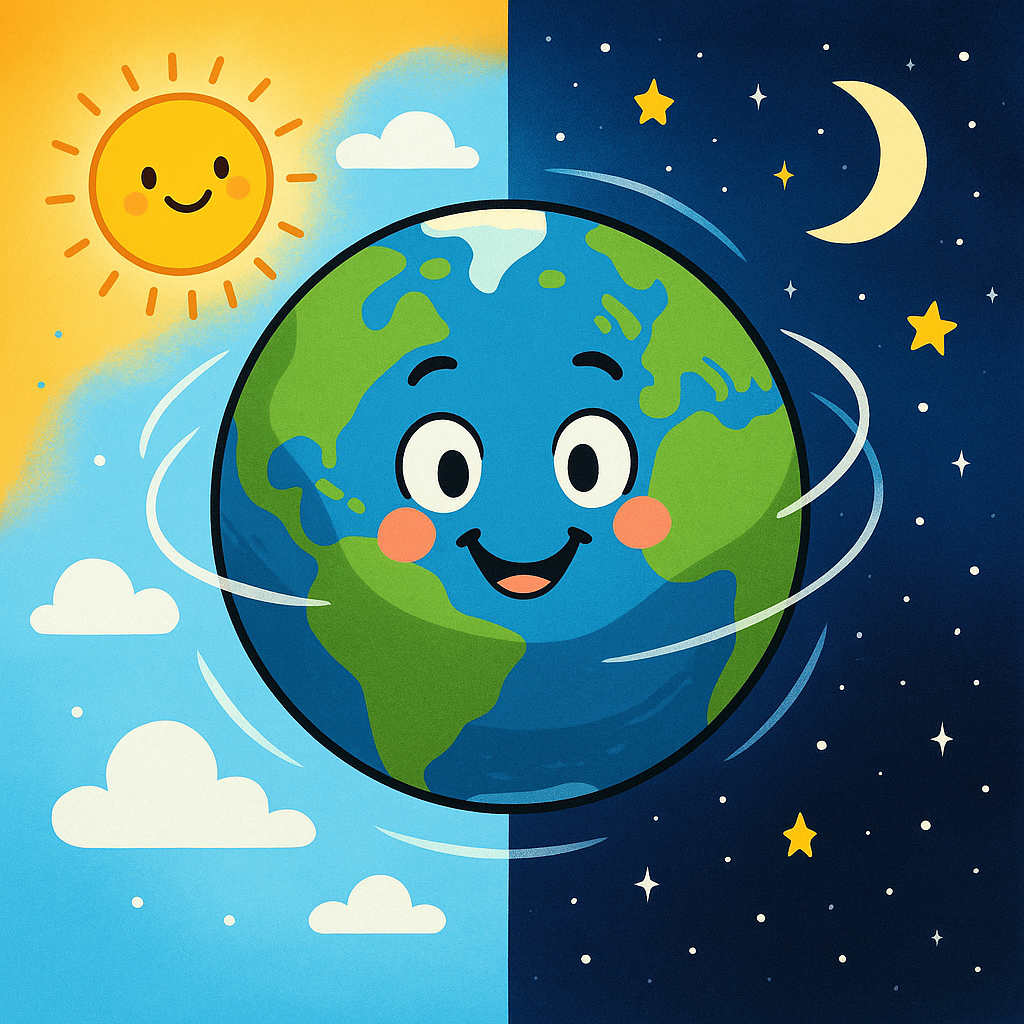
The most direct and significant consequence of this axial rotation is the creation of the day-night cycle. As the Earth spins, the hemisphere facing the Sun is illuminated and experiences daytime, while the opposite hemisphere is cast in shadow and experiences night. This continuous rotation ensures a perpetual transition between light and darkness across the globe.
2.2 Apparent Motion of Celestial Bodies
From our perspective as observers on a rotating planet, the Earth’s steady West-to-East spin creates the apparent daily motion of celestial bodies across the sky. The Sun, the Moon, and the stars all appear to rise in an eastward direction, traverse the sky, and set in a westward direction. This is a direct consequence of our own motion; the celestial objects are relatively stationary, and it is our vantage point that is moving.
This concept was articulated with remarkable clarity by the ancient Indian astronomer Aryabhata in his fifth-century CE treatise, the Aryabhatiya, where his astronomical knowledge is preserved in the form of rhythmic shlokas. He provided a powerful analogy to explain this perceptual phenomenon:
“Just as a man in a boat moving forward sees stationary objects as moving backwards, so also the stars that are stationary are seen… as moving towards the west.”
This principle also explains why the Pole Star, known as Dhruva Tara, appears nearly stationary in the northern sky while other stars seem to wheel around it. Earth’s axis of rotation points very close to Dhruva Tara, making it a fixed pivot point in the night sky from our perspective. Furthermore, Aryabhata’s work was not merely philosophical; he calculated the Earth’s rotational period with impressive accuracy, stating a value that, in modern units, corresponds to approximately 23 hours, 56 minutes, and 4.1 seconds.
2.3 The Dynamics of Orbital Revolution
In addition to its daily rotation, the Earth is in a constant state of revolution—its orbital motion around the Sun. This journey defines our year, as a single, complete revolution takes nearly one year to finish.
The primary observational consequence of this annual journey is the changing panorama of the night sky. As the Earth occupies different positions in its orbit, our nighttime view points towards different sections of the cosmos. This is why the constellations visible at a certain time of night change over the course of the months. While Earth’s rotation governs the daily cycle, its revolution is the foundation for our annual cycle. The crucial missing piece of the puzzle, however, is the planet’s axial tilt, which transforms this annual journey into the distinct seasons we experience.
3.0 The Mechanics of Earth’s Seasons
The predictable cycle of seasons is a direct consequence of Earth’s axial tilt in combination with its revolution around the Sun. A prevalent misconception attributes the seasons to the planet’s changing distance from the Sun; this is incorrect. Dismantling this misconception is strategically important for effective science communication, as the true cause lies in the orientation of our planet’s axis relative to the incoming solar radiation throughout its annual orbit.
3.1 The Decisive Role of Axial Tilt
The Earth’s axis of rotation is not perfectly upright with respect to its orbital plane; it is tilted. This axial tilt, combined with the Earth’s spherical shape, is the fundamental mechanism responsible for producing the seasons. As the Earth revolves around the Sun, this constant tilt means that at different points in the orbit, either the Northern or Southern Hemisphere is angled more directly towards the Sun, leading to variations in the duration and intensity of sunlight received.
3.2 An Analysis of the Solstices
The effect of the axial tilt is most pronounced at the solstices, which mark the longest and shortest days of the year. The following table provides a comparative analysis of conditions in the Northern Hemisphere during the June and December solstices.
| Condition during June (Northern Summer) | Condition during December (Northern Winter) |
| The Northern Hemisphere is tilted towards the Sun. | The Northern Hemisphere is tilted away from the Sun. |
| Solar energy is concentrated over a smaller area, resulting in more direct and concentrated solar energy (higher insolation). | The same amount of solar energy is spread over a larger area due to the oblique angle of the sunrays, resulting in less concentrated energy (lower insolation). |
| The duration of daylight is more than 12 hours. | Places in this hemisphere are in darkness for more than 12 hours. |
| The North Pole experiences 24 hours of continuous sunlight. | The North Pole experiences 24 hours of continuous darkness. |
3.3 Hemispheric and Latitudinal Variations
The orientation that causes summer in one hemisphere simultaneously causes winter in the other. Consequently, the seasons are reversed in the Southern Hemisphere relative to the Northern Hemisphere. When it is summer in the north in June, it is winter in the south, and vice versa in December. For millennia, human cultures have adapted to these cycles; for instance, indigenous communities in India, like the Bhil and Pawara, traditionally used the appearance of certain constellations to forecast the arrival of the monsoon.
Furthermore, the effect of seasons is not prominent in regions near the equator. These areas experience approximately 12 hours of daylight and 12 hours of darkness year-round, and there is little difference in the intensity of sunrays they receive in different months. Therefore, the pronounced seasonal shifts experienced at higher latitudes are largely absent. This steady progression of seasons, driven by tilt and orbit, sets the stage for the more transient, alignment-based phenomena of eclipses.
4.0 The Mechanics of Eclipses
Eclipses are among the most dramatic celestial events visible from Earth, resulting from the precise, temporary alignment of the Sun, Earth, and Moon. While the required alignments seem straightforward, they do not occur monthly. This is because the Moon’s orbit is tilted by approximately 5 degrees relative to Earth’s orbital plane (the ecliptic). Eclipses can only happen when the Moon crosses the ecliptic during a new or full moon phase—points in its orbit known as lunar nodes. Understanding these events requires an appreciation of the geometric relationship between these three bodies and, in particular, the foundational concept of apparent size.
4.1 The Principle of Apparent Size
Apparent size refers to the size of an object as it is perceived by an observer. It is a function of both the object’s actual physical size and its distance from the observer. This principle is key to understanding how eclipses are possible.
From our vantage point on Earth, the Sun and the Moon have remarkably similar apparent sizes. This is a cosmic coincidence: the Moon is much smaller in physical size than the Sun, but it is also proportionally much closer to us. This proximity makes its apparent size nearly identical to that of the distant Sun, allowing the Moon to cover the entire solar disc during a total solar eclipse. An additional layer of nuance is that because the orbits of the Earth and Moon are elliptical, their distances and apparent sizes vary slightly. This variation explains why some solar eclipses are total, while others are annular, occurring when the Moon is farther away and appears slightly smaller than the Sun, leaving a brilliant “ring of fire” visible.
In contrast, planets like Mercury and Venus, despite being physically larger than the Moon, are much farther away. Consequently, their apparent sizes are significantly smaller than the Sun’s. When they pass between the Sun and Earth, they appear only as tiny black dots moving across the Sun’s bright face—an event known as a “transit,” not an eclipse.
4.2 Solar Eclipses: The Moon’s Shadow on Earth
A solar eclipse occurs when the celestial alignment is Sun-Moon-Earth, with the Moon passing directly between the Sun and the Earth. In this configuration, the Moon blocks sunlight from reaching our planet and casts its shadow upon the Earth’s surface.
The type of solar eclipse an observer witnesses depends entirely on their location within this shadow:
- Total Solar Eclipse: Observers located within the small, central area of the Moon’s shadow will see the Moon completely block the Sun. During totality, the sky darkens, and just as the Sun begins to reappear, the stunning “diamond ring” effect may be visible.
- Partial Solar Eclipse: Observers in the larger surrounding area of the shadow will see only a part of the Sun blocked by the Moon.
It is critically important to observe a solar eclipse safely, as looking directly at the Sun can cause permanent eye damage.
Safe Solar Eclipse Viewing Protocols
- Never look directly at the Sun with the naked eye or through standard sunglasses, cameras, binoculars, or telescopes.
- Use specialized and certified solar eclipse goggles designed to filter harmful radiation.
- Project an image of the Sun onto a screen or wall using a small mirror or a pinhole projector. This indirect viewing method is entirely safe.
4.3 Lunar Eclipses: The Earth’s Shadow on the Moon
A lunar eclipse occurs when the celestial alignment is Sun-Earth-Moon, with the Earth passing directly between the Sun and the Moon. In this arrangement, the Earth itself blocks sunlight from reaching the Moon. The mechanism involves the full Moon passing into the Earth’s shadow. Unlike a solar eclipse, which is visible only from a very narrow path on Earth, a lunar eclipse can be seen by any observer on the night side of the planet. This is why lunar eclipses are far more widely observed than their solar counterparts.
These precise alignments, producing shadows that either fall upon the Earth or are cast by it, provide a dramatic capstone to the fundamental principles of celestial motion.
5.0 Conclusion: A Synthesis of Celestial Mechanics
The daily, annual, and episodic celestial events that define our experience on Earth are the elegant and predictable outcomes of a few fundamental principles of motion and geometry. This monograph has deconstructed these phenomena to reveal the clear causal relationships at their core.
- Earth’s rotation on its axis is the mechanism for the day-night cycle and the apparent motion of celestial bodies across the sky.
- The combination of Earth’s axial tilt and its revolution around the Sun is the mechanism that produces the seasons.
- A solar eclipse is the result of the Sun-Moon-Earth alignment, where the Moon’s shadow falls on the Earth.
- A lunar eclipse is the result of the Sun-Earth-Moon alignment, where the Earth’s shadow falls on the Moon.
From the steady rhythm of day and night to the rare and stunning alignment of an eclipse, these observable phenomena are a profound demonstration of the physical laws governing our solar system.