
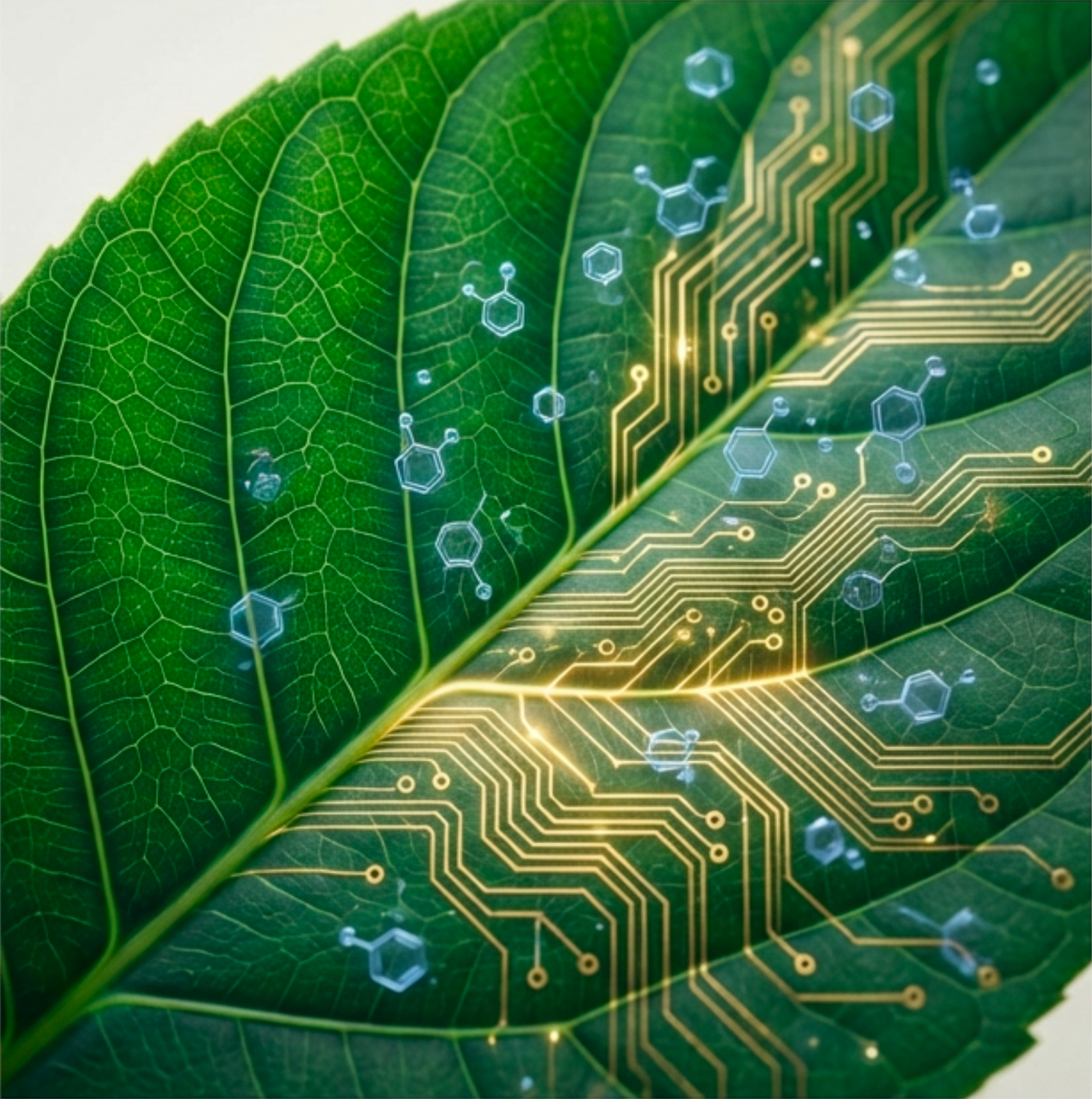
Introduction: The Planet’s Greatest Innovation Has a Few Bugs
For billions of years, plants have performed a trick that feels like magic: they take sunlight, water, and carbon dioxide and turn them into energy. This process, photosynthesis, built our atmosphere, is the silent engine powering nearly every food web on the planet, and remains life’s greatest innovation. But for all its elegance, natural photosynthesis has a few surprising limitations.
When it comes to pure efficiency, a typical leaf converts only about 3-6% of sunlight into chemical energy. Nature optimized plants for survival and reproduction, not for maximum energy output. Their end products are glucose and biomass—essential for life, but not exactly what you’d put in your car.
This isn’t a critique of nature, but an incredible opportunity for human ingenuity. What if we could learn from nature’s blueprint and then engineer systems that surpass it? This is the central goal of artificial photosynthesis, a field dedicated to creating technologies that use sunlight, water, and CO2 to generate clean fuel and valuable materials. By stripping away the biological constraints of a living plant, scientists are achieving breakthroughs that could redefine our energy future. Here are six of the most exciting developments.
1. Surpassing Nature: We’re Engineering Systems That Are More Efficient Than a Real Leaf
1.1. The Core Concept of Efficiency
Natural photosynthesis converts 3–6% of sunlight into the chemical energy stored in glucose. This rate is the result of billions of years of evolution, optimized not for raw power but for the complex needs of survival and reproduction. Artificial systems, however, don’t need to grow, defend themselves, or reproduce. They can be engineered for one purpose and one purpose only: converting sunlight into a specific, high-value output like hydrogen fuel or industrial chemicals. This singular focus allows scientists to push the boundaries of efficiency far beyond what a leaf can achieve.
1.2. Breakthroughs in Materials
Two remarkable examples highlight this leap in performance:
- Hyper-Efficient Solar Cells: Perovskite solar cells are a leading material in this field. In one study, researchers led by Yoo and group developed a perovskite cell that achieved a certified power conversion efficiency of 25.2%. This figure corresponds to an incredible 80.5% of the thermodynamic limit of its bandgap (in other words, capturing over 80% of the maximum energy theoretically possible for a material with its specific properties), showcasing how close we are to perfect light capture.
- Rapid Starch Synthesis: A team led by Ma et al. developed a “cell-free chemoenzymatic” system to create starch directly from CO2. By taking the biological machinery out of the cell, they were able to optimize the process for pure speed. The result was a stunning conversion rate 8.5 times faster than starch synthesis in maize, one of nature’s most productive crops.
1.3. Analysis: Why This Is a Game-Changer
By decoupling energy production from the biological necessities of a living organism, scientists can create bespoke systems that are hyper-efficient at a single task. We are no longer limited by the slow, incremental pace of natural selection. Instead, we can design materials and pathways from the ground up to create energy and products on demand, at rates that nature never needed to achieve.
By focusing on pure chemical output rather than the complex needs of a living organism, artificial photosynthesis can leapfrog billions of years of evolution to achieve unprecedented levels of efficiency.
2. Upcycling Pollution: Turning Waste CO2 and Plastic into Valuable Resources
2.1. The “Waste as Feedstock” Paradigm
Imagine a world where our most persistent waste products—the CO2 warming our atmosphere and the plastic choking our oceans—become the primary raw materials for a new, sustainable economy. This is the revolutionary idea behind waste-to-value artificial photosynthesis. The core challenge is a chemical one: CO2 is a stubbornly stable, almost zen-like molecule. Breaking its powerful chemical bonds requires a massive energy input.
2.2. The CO2-and-Plastic Hybrid System
A pioneering photoelectrochemical (PEC) system developed by Reisner and colleagues tackles this challenge head-on. Their device performs a remarkable dual function, using only the power of sunlight to simultaneously upcycle CO2 and plastic waste without any external voltage.
Here’s how it works:
- Anode (Oxidation): At one end of the device, polyethylene terephthalate (PET) plastic waste is reformed into glycolic acid, a valuable industrial chemical. This process is remarkably efficient, converting the plastic with over 90% precision.
- Photocathode (Reduction): At the other end, which is powered by a light-absorbing perovskite material, captured CO2 is converted into useful products like carbon monoxide (CO), syngas (a mixture of CO and hydrogen), and formic acid.
Crucially, the system is tunable, meaning scientists can adjust the conditions to control which products are created, tailoring the output to specific industrial needs.
2.3. The Path to Bioplastics
Another groundbreaking approach uses biology to complete the loop. A system called “EMC2,” developed by Yuan et al., uses the microorganism Pseudomonas putida to convert CO2 into bioplastics. This electro-microbial technology represents a paradigm shift, demonstrating a new way to use CO2 as a direct feedstock for a diverse range of commodity chemicals that form the backbone of modern industry.
2.4. Analysis: Why This Is a Game-Changer
This technology represents a profound shift in how we approach environmental cleanup. It tackles two of the world’s most pressing crises—climate change and plastic pollution—in a single, elegant process. By turning a liability (waste) into an asset (feedstock), it fundamentally changes the economic calculation of waste management and creates a truly circular economy.
This technology reframes our entire concept of waste, creating a sustainable loop where pollution from our past is the raw material for the products of our future.
3. Nanoscale Engineering: Where the Tiniest Structures Unlock the Biggest Gains
3.1. The Importance of Nanotechnology in Catalysis
In the world of chemistry, surface area is everything. Reactions happen at the surface of a catalyst, so the more surface you can pack into a tiny space, the faster and more efficient your reaction will be. Nanostructures, with their incredibly high surface-area-to-volume ratios, provide an astronomical number of “active sites” for reactions to occur, making them essential for high-performance artificial photosynthesis.
3.2. Three Specific Nanotechnology Breakthroughs
- The “Field-Induced Reagent Concentration” Effect: Researchers led by Sargent et al. created gold electrodes shaped into sharp nanoneedles. They discovered that these tiny points generate powerful, localized electric fields. This field acts like a powerful tractor beam for molecules, physically pulling CO2 from the surrounding solution and concentrating it right at the catalyst’s surface. This dramatically improves the rate of CO2 reduction, overcoming a key bottleneck in the process.
- Controlling Chemistry by Changing Nanoparticle Size: A study by Chu et al. revealed an astonishingly simple way to control the output of a reaction. By simply adjusting the size of gold (Au) nanoparticles on their photocathode, they could precisely control the ratio of carbon monoxide (CO) to hydrogen (H2) in the syngas produced from CO2 reduction. This gives engineers a powerful dial to tune the fuel for different industrial applications, like the Fischer-Tropsch synthesis for creating liquid fuels.
- Engineering for Extreme Durability: A major challenge for any catalyst is that it degrades over time. A team led by Zhang et al. tackled this by creating a gelled FeCoW (iron-cobalt-tungsten) oxyhydroxide catalyst. This material proved to be remarkably stable, showing “no evidence of degradation after more than 500 h of operation” while performing the oxygen evolution reaction. This level of durability is a critical step toward creating commercially viable systems.
3.3. Analysis: Why This Is a Game-Changer
These breakthroughs demonstrate that control at the atomic and nanoscale level gives us unprecedented power over chemical reactions. This isn’t just about making things slightly better; it’s about using the fundamental laws of physics to manipulate matter in entirely new ways. We can now solve deep-rooted problems in efficiency, selectivity, and durability with a level of precision that was once confined to theory.
At the nanoscale, we can manipulate the fundamental forces of physics and chemistry to direct reactions with a precision that was previously unimaginable.
4. Lessons from Life’s Extremes: Borrowing Biological Tricks from the Toughest Organisms
4.1. Bio-inspiration from Extremophiles
To build robust artificial photosynthesis systems, scientists are turning to some of the toughest lifeforms on Earth: extremophiles. These organisms thrive in conditions of extreme heat, pressure, or pH, and the molecular machinery that allows them to survive—their enzymes—are marvels of natural engineering. By borrowing these pre-optimized components, we can build hybrid systems with incredible performance.
4.2. The Camel Liver Enzyme Discovery
Researchers led by Chafik et al. looked to an animal renowned for its ability to survive harsh desert conditions: the camel. They purified an enzyme called carbonic anhydrase (CA) from a camel’s liver and found it was uniquely suited for carbon capture. The enzyme is exceptionally stable and efficient at high temperatures (up to 60°C) and high pH (9.0). When put to the test, it was highly effective at converting CO2 into solid calcium carbonate (CaCO3), sequestering 966.67 mg of the mineral for every milligram of enzyme.
4.3. The Proton-Pumping Power of Bacteriorhodopsin
Bacteriorhodopsin (bR) is a protein found in ancient microorganisms called archaea, such as Halobacterium salinarum. In simple terms, it’s a light-powered proton pump. At the heart of this protein is a molecule called retinal—the same type of molecule that helps our own eyes detect light. When retinal absorbs a green photon, the protein changes shape and moves a single proton across a membrane. This action creates an electrochemical gradient—like a tiny biological battery—that the organism uses to generate energy (ATP). Scientists are now incorporating bR into hybrid structures with semiconductors like TiO2 and ZnO to create novel bio-photovoltaic cells and systems that can produce hydrogen.
4.4. Analysis: Why This Is a Game-Changer
This approach, sometimes called “bioprospecting,” is about finding solutions to modern engineering problems that evolution has already solved. Nature’s library is filled with highly efficient, pre-optimized molecular machines that perform incredibly complex tasks. Learning to read that library gives us access to components that would be almost impossible to design from scratch, saving decades of research and development.
Nature has already created a vast library of high-performance molecular machines; by learning to read it, we can find ready-made solutions to our most complex energy challenges.
5. The Living Factory: Creating Self-Repairing, Hydrogen-Producing Lifeforms
5.1. The Challenge of Durability in Artificial Systems
One of the biggest hurdles for purely artificial photosynthetic systems is their limited lifespan. Materials inevitably degrade under constant exposure to light and reactive chemicals. Living organisms, on the other hand, have a built-in solution: self-repair. They constantly maintain and rebuild their own components, giving them a durability that synthetic devices struggle to match.
5.2. In Vivo Engineering: A Hydrogen Factory Inside a Cell
A team led by Gutekunst et al. achieved a landmark breakthrough by engineering a new lifeform. They took a hydrogen-producing enzyme (a hydrogenase) and fused it directly to Photosystem I (the part of the photosynthetic machinery that generates high-energy electrons) inside a living cyanobacterium (Synechocstis sp.). The resulting mutant organism grows normally but, under the right conditions, directly channels solar energy into producing hydrogen gas. Because the entire system is alive, it is capable of self-repair, overcoming the lifespan limitations of artificial devices. The organism was able to produce a high concentration of hydrogen (500 μM) in laboratory tests.
5.3. The Hybrid “Cyborg” Bacteria Approach
In a different but equally creative approach, Wong et al. created a hybrid “cyborg” system. Imagine coating a living photosynthetic bacterium (R. palustris) with tiny solar panels. That’s essentially what they did, using cadmium sulfide (CdS) nanoparticles. When exposed to light, these nanoparticles act as external light absorbers, constantly generating photocurrents and pumping electrons into the cell. This creates an energy surplus—a state scientists call “reducing stress.” To avoid being overwhelmed, the cell’s natural metabolic machinery kicks into overdrive, using that excess energy to pull more CO2 from its environment and convert it into valuable chemicals. It’s a brilliant hack: supercharging a natural process by creating a problem only it can solve.
5.4. Analysis: Why This Is a Game-Changer
These approaches blur the line between synthetic biology and materials science. We are moving beyond simply mimicking nature to actively co-opting and augmenting it. This opens the door to creating self-replicating, self-repairing “bio-factories” that use sunlight as their only input to sustainably produce clean fuels and chemicals on demand.
Instead of just building machines that copy nature, we are now beginning to edit nature itself to create living devices that can grow, self-repair, and produce clean fuel.
6. The Power of the Platform: Building Scaffolds to Stabilize and Supercharge Catalysts
6.1. The Problem of Unruly Molecules
Some of the most effective catalysts for artificial photosynthesis are molecular, designed to mimic the active sites of natural enzymes. However, these complex molecules can be fragile and difficult to control when floating freely in a solution. They can clump together, deactivate, or simply not work as efficiently as they could.
6.2. The “Scaffolding” Solution
The solution is to give these molecular catalysts a stable home by anchoring them onto solid supports, or “scaffolds.” This strategy not only holds the catalysts in place but also creates a perfect microenvironment to maximize their performance. Two key materials have emerged as leading platforms:
- Metal-Organic Frameworks (MOFs): These are crystalline, sponge-like structures with incredibly high internal surface areas. In one study, Pullen and group incorporated a molecular catalyst that mimics the [FeFe]-hydrogenase enzyme into a zirconium-based MOF. They found that the immobilized catalyst showed “substantially improved initial rates and overall hydrogen production” compared to the same catalyst in solution. The rigid MOF provided structural stabilization, protecting the catalyst and allowing it to work more effectively.
- Silica-Based Materials: Silica is chemically robust and versatile, making it another excellent support material. Researchers have used periodic mesoporous organosilica—a type of highly ordered, porous silica—to anchor similar diiron complexes for light-driven hydrogen production, demonstrating a powerful and flexible platform for catalyst engineering.
6.3. Analysis: Why This Is a Game-Changer
This work shows that building a better catalyst is not just about discovering the right molecule; it’s also about creating the perfect architectural environment for that molecule to thrive. Using an analogy, the MOF or silica scaffold acts like a factory assembly line. It holds the molecular “workers” (the catalysts) in the perfect position to do their job efficiently while protecting them from damage, unleashing their full potential.
The next frontier in catalysis is not just discovering new molecules, but engineering the perfect architectural environment to unleash their full potential.
Conclusion: A Future Written in Sunlight
The dream of artificial photosynthesis is no longer science fiction. From perovskite cells that approach the theoretical limits of physics to “cyborg” bacteria augmented with nanoscale solar panels, we are building systems that can do what plants do, only better. By combining powerful insights from chemistry, materials science, nanotechnology, and biology, we are on the cusp of mastering our own form of photosynthesis—one that is more efficient, more durable, and capable of producing a vast range of products, from clean hydrogen fuel to bioplastics.
These breakthroughs offer a tangible path toward a future that can meet our energy needs, clean our atmosphere, and upcycle our most persistent waste. The science is complex, but the vision is simple: a world powered by little more than sunlight and water. As we learn to harness the power of a star with the elegance of a leaf, what kind of world will we choose to build?